The Cup That Shocked Two Millennia
A first-century Roman silver drinking cup, 11 cm tall, depicting two homoerotic scenes in hammered relief — and one of the most consequential objects in the British Museum. The Warren Cup (GR 1999,0426.1, c. 5–15 CE) spent most of the twentieth century in an attic, in a U.S. Customs impound, and rejected by institutions whose trustees included the Archbishop of Canterbury. This article traces its full biography: from a Roman symposium table to Edward Perry Warren's Sussex manor, to a £1.8 million acquisition and a retracted forgery accusation.
In Room 70 of the British Museum, amid marble busts and bronze statuettes of emperors, a small silver drinking cup sits inside a case without drama or ceremony. It is eleven centimeters tall — shorter than a standard coffee mug — and its surface has darkened to the color of old pewter. 1 Two thousand years of tarnish have softened the relief figures on its walls, but not enough. Lean close and you can still see, worked in hammered silver with extraordinary precision, two scenes of men making love.
The cup is accession number GR 1999,0426.1. It has been in Room 70 since 1999, which sounds like a short time for a first-century Roman object to have been on public display. It is. The cup spent most of the twentieth century in attics, in customs impound, and in the hands of collectors who could neither exhibit it nor sell it without scandal. A U.S. customs official confiscated it as pornography. The Archbishop of Canterbury, as chair of the British Museum's board of trustees, blocked the museum from acquiring it. It was declared a forgery by a Berlin professor in 2014 — and he turned out to be wrong. 2
The cup's biography, as objects go, is unusually action-packed. But what the cup actually is — what it was made for, what it shows, and why the Romans apparently saw nothing extraordinary in passing it around a dinner table — is the stranger story.
Made for pleasure, consumed at pleasure
The cup was made in Roman Italy sometime between roughly 5 and 15 CE, during the reign of Augustus or the very early years of his successor Tiberius. 1 It belongs to a tradition of luxury tableware that the wealthy Roman world took seriously enough to call argentum escarium — silver for eating — and a matching category, argentum potorium, silver for drinking. Owning fine silver service was a statement of status in a culture that spent considerable ingenuity calibrating the gradations of social rank.
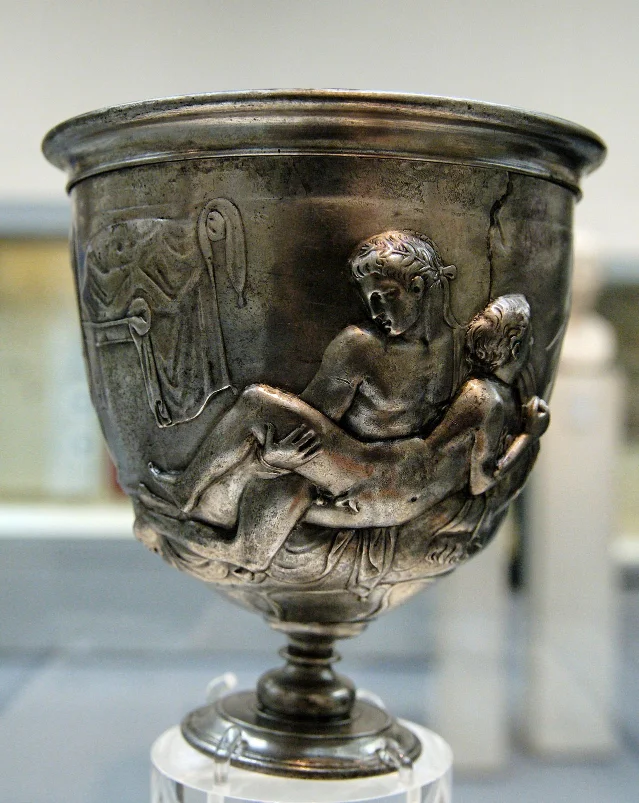
This particular cup is a skyphos (a two-handled drinking vessel in the Greek style), made in five parts: an outer bowl with the figurative relief hammered from the inside out; a plain inner liner of thicker silver with a solid rim to make it practical to drink from; a solid base; a cast pedestal foot; and two vertical handles now lost. 1 The technique is called repoussé — the silversmith worked with a hammer from the interior, raising figures on the outer surface, then refined the detail from outside. It is extraordinarily demanding. The figures on the Warren Cup stand in high relief, with bodies fully modeled in three dimensions, their musculature and the folds of their clothing shaped with the same care a sculptor would give marble.
The material itself confirms its antiquity. Chemical analysis by the British Museum found the silver to be approximately 95% pure, with traces of copper, lead, and gold — a composition consistent with Roman refining techniques. 1 Silver refined using nineteenth-century industrial methods would be nearly pure; the impurities in the Warren Cup are a fingerprint of ancient metallurgy, a fact that would become relevant in 2014.
A cup of this quality would have cost around 250 denarii — enough, as a measure, to buy an unskilled slave, two-thirds of an acre of arable land, or twenty-five large jars of the best available wine. 1 It was made for symposia, the private, all-male dinner parties at which Roman elite culture did much of its real work: politics, philosophy, business, and the pleasures that the public sphere officially discouraged. The cup would have been filled with wine mixed with water and spiced with honey, and passed around the reclining guests on their dining couches. The figures on its surface would have rotated through each drinker's hands.
What the silver says
The two scenes wrapped around the cup are not subtle. They were not intended to be.
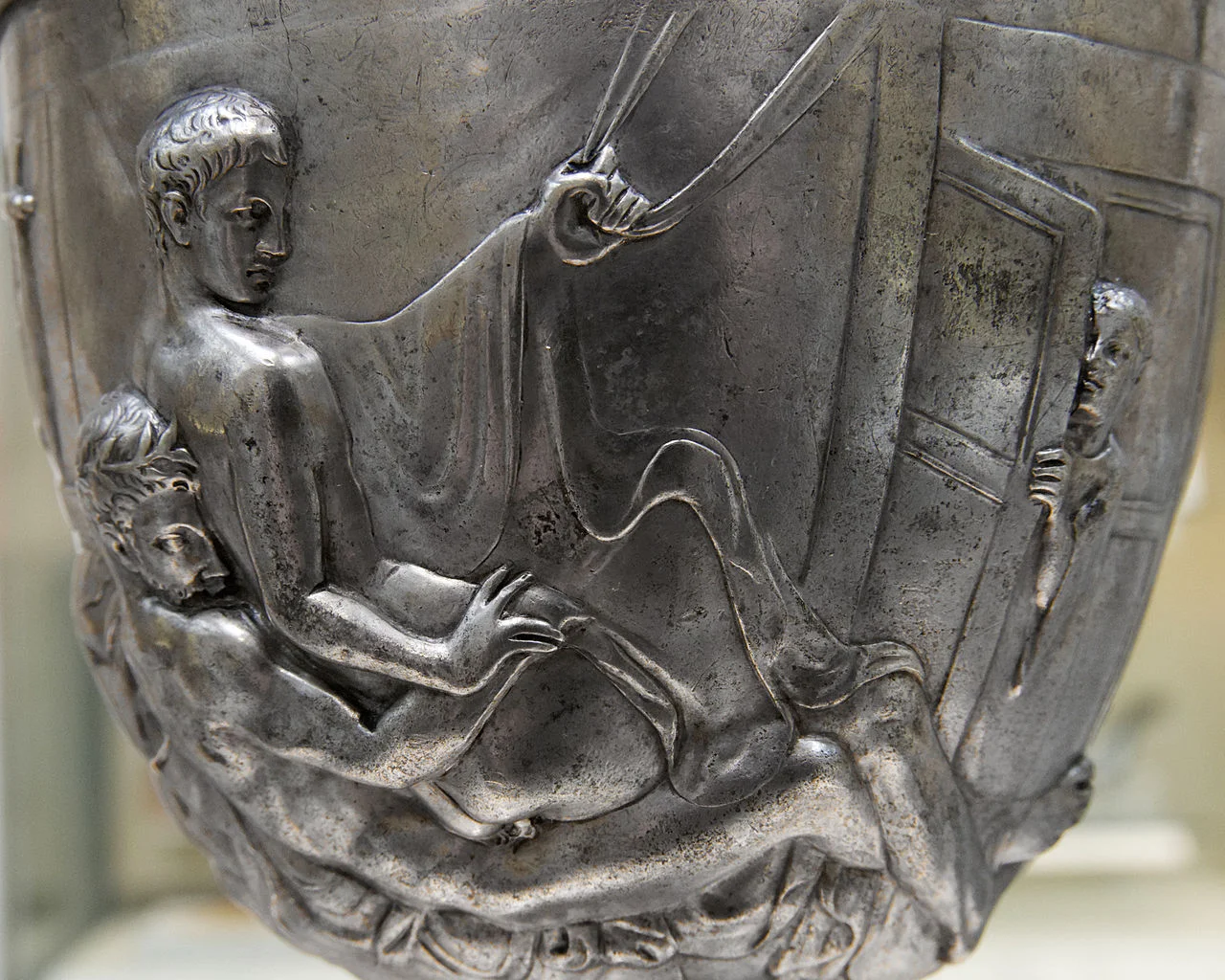
Turn the cup to what scholars call Side A, and you encounter an older, bearded man and a beardless youth engaged in penetrative sex on a draped couch. The youth is lowering himself onto the man's lap, steadying himself with a strap or sash looped from a hook above — a practical detail the silversmith did not need to include but did. A kithara, an eleven-stringed lyre, rests against a chest in the background, signaling the educated, cultured domestic interior of a wealthy household. Half-concealed behind a partially open door on the right edge of the scene, a small slave boy peers in, only half his face visible: a witness to what is meant to be private. Both men wear myrtle-leaf crowns. 1
Art historian John Pollini, who published a detailed analysis of the cup's iconography in the Art Bulletin in 1999, argues that the myrtle crowns are a deliberate visual joke. Myrtle was used for the corona ovalis, a lesser military award given to commanders who had won a victory not quite glorious enough for a triumph — inferior, in other words, to the laurel crown of the full triumph. Pollini reads this as a wry suggestion that homosexual penetration is an "easy victory" compared to the harder-won laurels of military conquest. 1 Whether or not ancient viewers caught the pun, the inclusion of two small myrtle wreaths atop two naked figures locked together is either a coincidence or a piece of sophisticated wit.
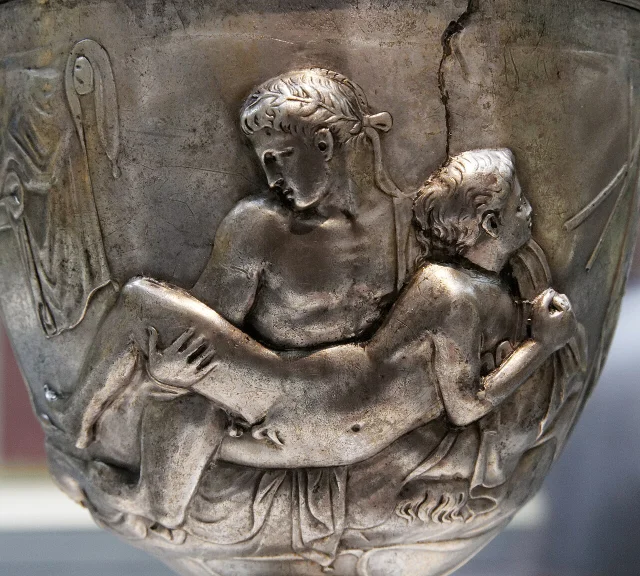
Rotate the cup to Side B, and the scene shifts slightly in register. Here a beardless young man penetrates a smaller, long-haired boy. Auloi — reeded double pipes — hang from the wall above a folded textile, again establishing the elite Hellenized interior. The boy's hairstyle, with its distinctive long trailing lock, identifies him in the conventions of Greek iconography as a puer delicatus, a free-born youth between roughly fourteen and eighteen, whose long hair would be cut and dedicated to the gods upon reaching manhood. 1 What is unusual, as historian Bettany Hughes has noted, is the boy's apparent engagement: unlike Greek vase painting, where the passive partner is typically depicted as emotionally distant, the boy on Side B appears to grasp his lover's arm with something that reads as tenderness rather than endurance. 3 Both figures wear the same myrtle crowns.
Hughes has described Side B as "a lot more kind of lyrical, a rather idealised view of what homosexuality was." 3
The Roman alibi
Neither scene is without scholarly complexity. John R. Clarke's 1993 Art Bulletin analysis noted a key tension: Side B more or less maps onto acceptable Roman norms — a citizen-age man with a younger subordinate — while Side A shows partners who appear close in age and status, which would have been socially anomalous in Rome. 1 Pollini's 1999 reading tried to resolve this by arguing both sides show pederastic relationships between free-born males, just at different points on a spectrum. Neither interpretation is settled.
What is agreed on is that the scenes are set in a conspicuously Greek visual idiom — the musical instruments, the freeborn boy's hairstyle, the draped and furnished interiors. The Roman world used Greek culture as a moral displacement zone. James Davidson, author of The Greeks and Greek Love, has put the mechanism plainly: "The Greek world provided an alibi for societies to think about homosexuality, to talk about homosexuality, to represent homosexuality. It made it into a piece of art more than pornography, so it's a kind of cover, if you like, for something which is not necessarily very easy to depict." 3
This "Greek alibi" was useful precisely because Roman sexual ethics operated on entirely different axes than modern ones. The Roman framework was not a homosexual/heterosexual binary but an active/passive one: a free-born male citizen could penetrate social inferiors — slaves, prostitutes, entertainers, all classified as infames — without disgrace. Being penetrated, by contrast, was a surrender of dignitas, masculine authority, and could result in the loss of political rights. The Augustan moral reform legislation (the lex Julia de adulteriis of 18 BCE) addressed marital fidelity but left the active/passive structure essentially intact. 4 The playwright Plautus had summarized the permissible range a century earlier in Curculio: "Love whatever you wish, as long as you stay away from married women, widows, virgins, young men and free boys." 4
The Warren Cup's figures — whatever the exact status relations depicted — sat on the dinner table during meals at which Ovid's Ars Amatoria might be quoted and Greek erotic philosophy discussed without anyone calling the guards. Its companion piece on the shelf at the British Museum, the Portland Vase (c. 1–25 CE, Room 70), was made at almost exactly the same moment, deploying the same high mastery of luxury decorative arts in service of equally coded mythological narratives. 5 The same elite world produced both objects. Only one of them ended up in a customs impound.
The man who needed a Holy Grail
The cup's path from Roman Italy to Room 70 required a particular kind of collector, at a particular moment, with particular needs.
The most plausible reconstruction of the cup's first eighteen centuries is that it was buried near Bittir (ancient Betar), a town a few miles southwest of Jerusalem, sometime around 66–73 CE — the years of the First Jewish–Roman War, when its owner may have concealed the silver service while fleeing the fighting. 1 It was found, reportedly accompanied by coins of the Emperor Claudius, in the early years of the twentieth century, and made its way from Jerusalem to the Rome antiquities market. 3 The exact finder and circumstances are undocumented, as is standard for unexcavated antiquities of that period.
In Rome, in 1911, it found its buyer.
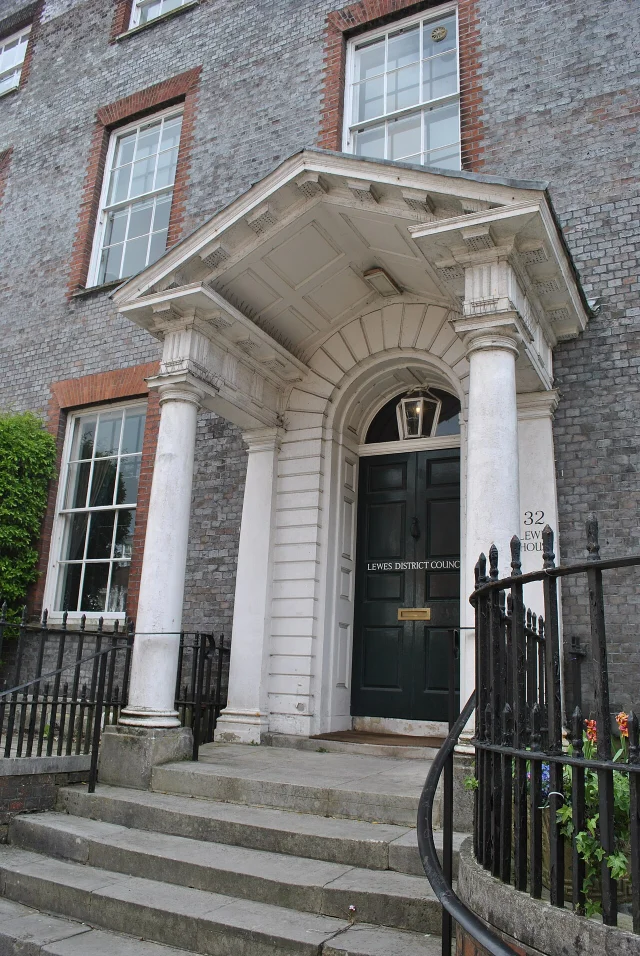
Edward Perry Warren (1860–1928) was a wealthy American expatriate who had spent the previous two decades assembling one of the largest private collections of classical antiquities in the world. 6 He was the son of Samuel D. Warren, a Boston paper-mill magnate, had read classics at Harvard and Oxford, and had since 1889 been living at Lewes House, an eighteenth-century mansion in East Sussex, with his partner John Marshall. Together Warren and Marshall had supplied the Museum of Fine Arts in Boston with the core of its classical collection — they dominated the antiquities market on behalf of American institutions for years. But the Warren Cup was not for any museum.
Warren paid £2,000 for it (roughly £204,000 in 2025 terms) 1 and referred to it among friends as his "Holy Grail." 1 He never attempted to sell it. He was, in the circumlocutions of Edwardian England, a man who loved Greece in every sense — drawn to Classical antiquity partly through intellectual passion and partly because its literature and visual culture supplied a vocabulary, and a historical legitimacy, for desires that the England of Oscar Wilde's trials punished as crimes. Warren would eventually publish a three-volume philosophical defense of same-sex love, A Defence of Uranian Love (1928–30), under the pseudonym Arthur Lyon Raile, arguing from Classical Greek and Roman precedents that pederastic relationships between men of different ages were a legitimate model for human affection. 6 The Warren Cup illustrated the argument in silver.
Warren was also a collector of spectacularly varied tastes: he commissioned from Auguste Rodin a full-scale marble version of The Kiss, specifying in the contract that the male figure's genitals were to be anatomically complete. (The Lewes town council, offered the sculpture as a gift, declined and returned it after two years; it is now at Tate Modern.) 6 His circle at Lewes House included Bernard Berenson and Matisse. John Marshall, whom Warren called "Puppy" and who died speaking that word to Warren three months before Warren himself died, was described by the classicist J.D. Beazley as speaking always of Warren "as in a class much superior to himself as an archaeologist." 7\
Warren lent the cup to the Martin von Wagner Museum in Würzburg for a period in the 1920s, and included photographs of it in A Defence of Uranian Love. Otherwise it stayed at Lewes House, shown to trusted eyes. When Warren died in December 1928, the cup passed to his secretary Asa Thomas.
The decades in the dark
The 1929 Lewes House auction — a sale of Warren's remaining collection — failed to sell the cup. 1 This was not a surprise. The Edwardian world that had housed Warren's library of Greek erotica was giving way to something less tolerant, and the cup was, legally speaking, obscene in most jurisdictions. It spent the following years in Asa Thomas's attic.
In 1952, Harold W. Parsons, an art historian who had been part of Warren's circle, began trying to arrange a sale, approaching a New York collector named Walter Baker. 1 In February 1953, Thomas mailed the cup to Baker. U.S. Customs officials in New York opened the package, reviewed the contents, and confiscated it as pornographic material. 1 A ruling from Washington was required. The United States government formally refused entry. It took until October 1954 to have the cup returned to Britain. By that point, Thomas had died. 3
Thomas's widow sold the cup to London antiquities dealer John K. Hewett, who approached Denys Haynes, Keeper of the Greek and Roman Department at the British Museum. Haynes was interested. He consulted Lord Crawford, a trustee of the museum. Both men recognized the cup's exceptional quality. Both men concluded that there was no chance of getting it past the Board of Trustees. 8 The reason, as Dyfri Williams — who would eventually secure the cup for the museum — later put it bluntly, was that there was "not a chance of getting the beautifully modelled homosexual imagery past the then chairman of the trustees — the Archbishop of Canterbury." 8 The Archbishop in question was Geoffrey Fisher, who held the Canterbury chair from 1945 to 1961. In 1955, the year the decision was likely made, homosexual acts between men remained criminal offenses in England. The Wolfenden Report recommending decriminalization would not appear until 1957, and the resulting law not until 1967.
In 1966, the cup sold for £6,000 — roughly £98,000 today 1 — to an unnamed private collector abroad. Sandy Martin, the dealer who handled the transaction, recalled the situation in a 1999 letter to The Times: "In those days (before the enactment of the Wolfenden report) the homosexual scenes decorating the cup precluded its acquisition by any museum and most collectors." 1
The cup surfaced for a longer run of semi-public display between 1985 and 1991 at the Antikenmuseum Basel und Sammlung Ludwig in Switzerland, and again from 1992 to 1998 at the Metropolitan Museum of Art in New York, where it was displayed as an "anonymous loan" — meaning visitors could see it, but the owner's identity was withheld. 1 In 1998 the Met loan ended, and the cup was sold to a British private collector. It was back on British soil.
The £1.8 million reversal
The British Museum moved quickly. In 1999, the trustees — no longer chaired by an archbishop, and operating in a Britain where the Sexual Offences Act 1967 had long since decriminalized what the cup depicted — approved the purchase. The price was £1.8 million (approximately £3.45 million in 2025 terms), 1 making it at the time the most expensive single acquisition in the museum's 246-year history. Funding came from the Heritage Lottery Fund, the National Art Collections Fund, and the British Museum Friends. The stated rationale was to prevent the cup from leaving the United Kingdom again. 1
As Neil MacGregor, who as museum director would later feature the cup in his BBC Radio 4 series A History of the World in 100 Objects (2010), observed: "It was only in 1999 — long after public attitudes to homosexuality, and indeed the law, had changed — that the British Museum bought the Warren Cup, then the most expensive acquisition it had ever made." 3
The price jump from £6,000 in 1966 to £1.8 million in 1999 — a factor of 300 — was not straightforwardly a function of the art market. It reflected the transformation of the legal and cultural context in which the cup could be owned, displayed, and discussed. The same object, in the same physical condition, had been nearly worthless in 1966 and worth a record price thirty-three years later.
The museum mounted the cup's formal public debut as a dedicated exhibition — "The Warren Cup: Sex and Society in Ancient Greece and Rome" — in Room 3 in May 2006, with a warning notice at the entrance: "Please note that the display contains sexually explicit images." 1 Dyfri Williams, who curated the show, added a Brokeback Mountain reproduction and a David Hockney drawing of two young men in bed. The cup was placed in its ancient context and its modern one simultaneously.
The forgery that wasn't
The cup's institutional peace lasted eight years before academic controversy arrived.
In 2013, Maria Teresa Marabini Moevs had published an argument in Italian academic journals that the cup was a modern forgery — crafted to match Edward Perry Warren's personal tastes rather than actual Roman iconographic conventions. 1 In March 2014, Luca Giuliani, professor of Classical Archaeology at Humboldt University Berlin, brought the argument to a public debate at King's College London. His core claim: "There is no other Roman silver tableware with a comparable subject matter. Silver vessels have a completely different iconography. Sexual escapades have no place here." 2 A skilled silversmith around 1900, knowing Warren's collecting interests, could have produced the cup for him — or Warren might have commissioned it himself. Giuliani noted that Warren had purchased other objects that turned out to be counterfeit. 2
Dyfri Williams, defending the cup at the same debate, pointed to the metallurgical evidence: post-1850 refining processes produce silver of near-total purity; the Warren Cup's 95% silver with copper, lead, and gold traces is only explicable as ancient-refinery output. "If the cup was made around 1900, as he claims, they would be using virtually pure silver," Williams said. "They have been refining silver since the middle of the 19th century." 2 He also cited the EDX (energy-dispersive X-ray spectroscopy) analysis, which had confirmed silver chloride corrosion products in the cup's crevices, consistent with long-term burial.
Williams's second argument was chronological. The closest stylistic parallel to the Warren Cup's relief figures is the Hoby skyphoi, a pair of silver cups found in Lolland, Denmark, dated to AD 10–20, showing nude male figures in closely matching technique. 1 The Hoby cups were first published and documented in 1921 — the same year as the first publication of the Warren Cup. No forger working around 1900 could have copied a stylistic parallel that wouldn't be discovered for another two decades. 1
Francesca Tronchin, an art historian who analyzed the controversy at length on her academic blog, raised the broader methodological issue: "Uniqueness for me is always shaky ground on which to build an argument against authenticity of an ancient object. One must be aware of the many lacunae we have in the archaeological record — could another silver cup with explicit homosexual imagery be excavated in some field project this summer?" 9
The question was answered not by a new excavation but by a closer examination of the cup itself. In 2015, Giuliani published a formal retraction in the journal Zeitschrift für Ideengeschichte under the title "Der Warren-Kelch im British Museum: Eine Revision." 1 The cause of the reversal: examination of the inside repoussé shelf and the reverse face of the inner liner — surfaces that had never been cleaned in modern times — found substantial silver chloride corrosion. This kind of corrosion cannot be faked. It develops over centuries of burial. Giuliani withdrew the forgery argument entirely.
What the cup is actually evidence of
The Warren Cup is not evidence of Roman homosexuality as a category — the Romans had no such category. It is evidence of a specific sexual economy, operating under specific social rules, that found it perfectly natural to serve wine in a cup depicting that economy's activities.
This is the harder thing to process, and the more historically interesting one. The cup did not require a subculture to produce or to use. Its original owner — whoever buried it near Jerusalem before the war came — was almost certainly a Roman citizen of means, living in what we might call the mainstream of Julio-Claudian elite culture. The scenes on the cup are Hellenized rather than explicitly Roman precisely because the Greek frame signaled sophistication rather than transgression. The symposium setting, the instruments, the cultured furniture: these cues meant that the men on the cup were men of taste and education, engaging in pleasures appropriate to their station.
As Bettany Hughes has described it: "This cup is telling us what actually went on, how homosexual activity was something which took place in high aristocratic circles... it's actually physically made from the inside out, so it's beaten from the inside and that's how you get the form on the outside, and that is almost what the Warren Cup is — it's a covert demonstration of what was actually going on in the real world outside." 3
The cup is covert not because its imagery is hidden — the scenes are about as explicit as silverwork can be — but because it places those scenes in a decorative frame that says: this is the correct aesthetic register for these activities. The kithara says culture. The myrtle crowns say celebration. The freeborn boy's hairstyle says precedent and tradition. Someone had the cup made as an affirmation, not a provocation.
Dyfri Williams, reflecting on the cup's double historical life, has said: "The Warren Cup has introduced us to some of the complexities surrounding the understanding of sexuality in antiquity, while its modern fate has pointed up some of the ways in which attitudes to sexuality have changed over the last century." 10
The cup's journey from a Roman dining table to an attic in Sussex to a U.S. Customs impound to a £1.8 million auction is not a story about an unusual object. It is a story about an ordinary object — ordinary for its time and place — that survived into a series of contexts that found it extraordinary, each for different reasons. The Romans saw nothing in it that required explanation. Nineteen-fifties England saw a criminal exhibit. The 1999 British Museum saw a record-price cultural treasure. The story of what happened to the cup between its creation and Room 70 tells us, with fair precision, when the twentieth century changed its mind.
| Detail | Value |
|---|---|
| Title | Warren Cup |
| Accession | GR 1999,0426.1 |
| Date | c. 5–15 CE (early Julio-Claudian period) |
| Culture | Roman |
| Medium | Silver (c. 95% pure), parcel gilt; repoussé relief |
| Dimensions | Height 11 cm; max width 9.9 cm |
| Weight | c. 0.9 kg |
| Findspot | Said to be near Bittir (ancient Betar), southwest of Jerusalem |
| Acquired by BM | 1999, for £1.8 million |
| Current location | British Museum, Room 70 (Roman Empire) |
Cover image: the Warren Cup overall view. Photo via Wikimedia Commons, CC BY-SA.
参考来源
- 1Wikipedia: Warren Cup
- 2The Guardian: German archaeologist suggests British Museum's Warren Cup could be forgery
- 3BBC Radio 4: A History of the World in 100 Objects — Episode 36 transcript
- 4Wikipedia: Homosexuality in ancient Rome
- 5Wikipedia: Portland Vase
- 6Wikipedia: Edward Perry Warren
- 7Wikipedia: John Marshall (died 1928)
- 8The Guardian: British Museum exhibition reveals saucy side of the ancient world
- 9Francesca Tronchin: New questions on the authenticity of the Warren Cup
- 10The Gay & Lesbian Review: The Warren Cup and Me
围绕这条内容继续补充观点或上下文。