The Kingdom in the Plaque: Benin's Stolen Archive
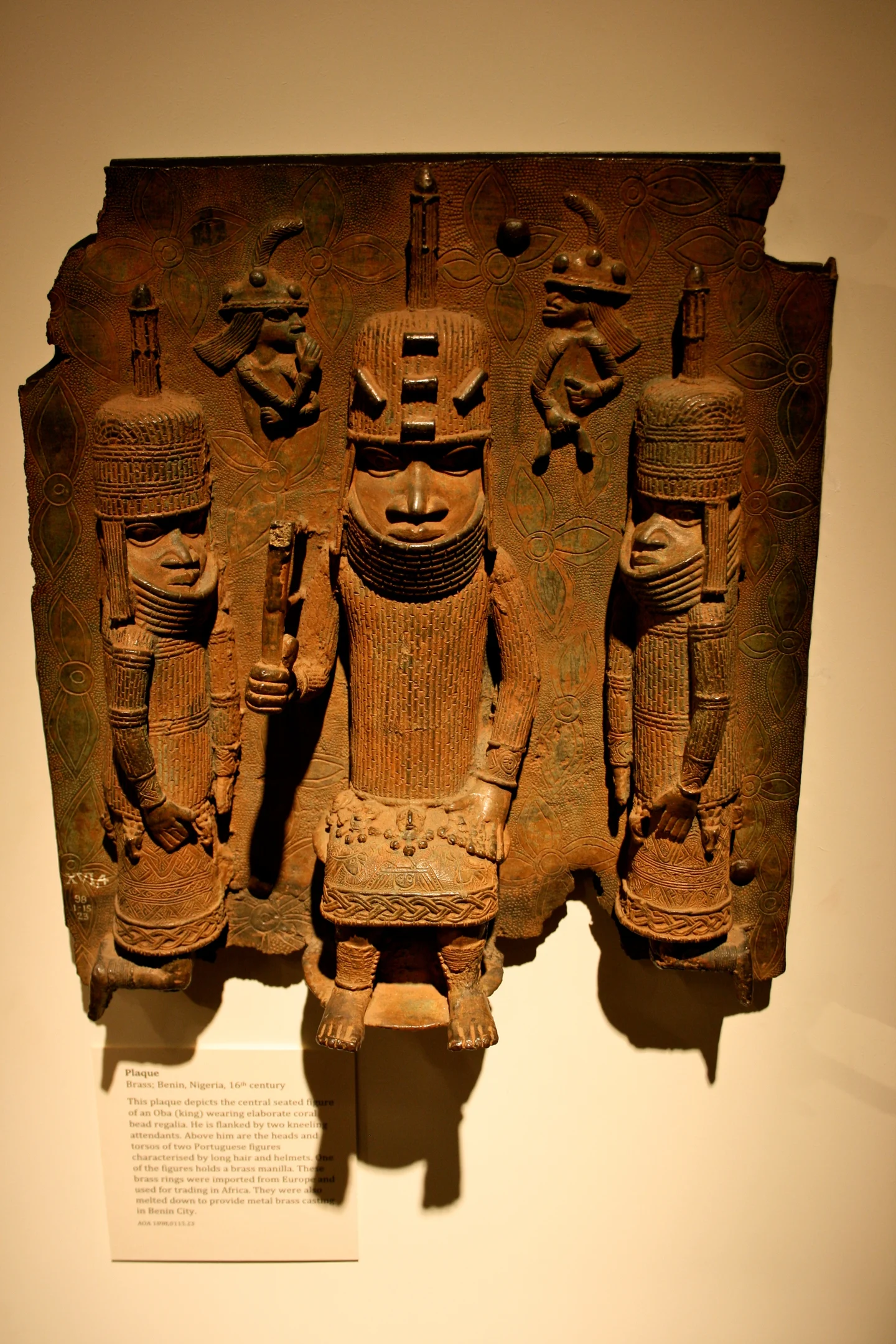
A 16th-century brass plaque (British Museum Af1898,0115.23) — depicting the Oba of Benin flanked by attendants and Portuguese figures — is read as a compressed political archive of a West African empire, from its creation in the Igun Eronmwon guild workshops through its seizure in the February 1897 British Punitive Expedition, its 125-year custody at the British Museum, and the turbulent 2022–2026 repatriation wave that has returned some 150 objects to Nigeria while leaving Af1898,0115.23 still in London.
In Room 25 of the British Museum — the Sainsbury African Galleries — a rectangular brass panel hangs on a white wall behind glass, roughly half the height of a person. 1 The museum's label gives it fifty-eight words. It identifies the piece as a plaque, brass, Benin, Nigeria, sixteenth century. It notes the accession number: Af1898,0115.23. It mentions the Oba — the divine king — standing in the center, flanked by attendants, with two Portuguese figures at the corners.
The label does not mention that this object was ripped from a palace wall by soldiers in February 1897. It does not mention the kingdom that made it, the court it governed, or the five hundred years of political memory compressed into its surface. It does not mention that roughly 5,000 to 10,000 objects were removed from Benin City that month in what Barbara Plankensteiner, co-spokesperson of the Benin Dialogue Group, has called "the largest theft of a royal treasure in history." 2
It does not mention that as of early 2026, Af1898,0115.23 is still here.
A kingdom the maps forgot
The Kingdom of Benin — no relation to the modern Republic of Benin to the west — was a West African state in what is now Edo State in southern Nigeria. 3 Its capital was Benin City, and it existed as a coherent political entity from approximately the thirteenth century until February 1897. 3 The kingdom grew from an earlier polity called the Igodomigodo; the Eweka dynasty, traditionally founded by Oranmiyan, a prince from the Yoruba holy city of Ife, introduced the title Oba — the divine king — in the thirteenth century. 3
The Oba was not a king in any European administrative sense. He was, in the Edo conception, divine — it was a capital offense to suggest he ate, slept, or performed any biological function. 3 He controlled trade through a palace bureaucracy of titled officials, the Eghaevbo n'Ogbe, and commanded a military that included specialized corps: the Ekaiwe royal troops, the Isienmwenro royal guards, crossbowmen. 3 At its sixteenth-century height under Oba Ewuare the Great (r. c. 1440–1473) and his successors, the kingdom's territory ran from the western Niger Delta to near what is now Accra, Ghana. 3
The palace complex in Benin City was, by multiple independent accounts, extraordinary. Dutch geographer Olfert Dapper, writing in 1668 from the records of Dutch merchants who had visited by 1644, described it as
"large as the town of Haarlem… It is divided into many magnificent palaces, houses and apartments of the courtiers, and comprises beautiful and long square galleries… resting on wooden pillars, from top to bottom covered with cast copper, on which are engraved the pictures of their war exploits and battles." 1
Those wooden pillars — the ones covered in cast copper — held the plaques.
Portuguese traders arrived in 1485 under João Afonso de Aveiro, inaugurating a commercial relationship that would later distort how Europeans understood the bronzes. 3 Brass manillas, the horseshoe-shaped currency rings manufactured in the Rhineland and carried west by Portuguese ships from roughly 1507 onward, entered the kingdom in quantity. 3 When the looted bronzes arrived in London in 1897 and British Museum curators Charles Hercules Read and O. M. Dalton struggled to explain them, their first hypothesis was that the metalworking tradition had come from the Portuguese — that no African kingdom could have achieved this independently. 1 The discovery in 1939 of bronze heads at Ife — dating to the fourteenth and fifteenth centuries, predating European contact — demolished that claim entirely. 1 The craft was indigenous. The manillas were raw material, not teachers.
The guild that worked in brass
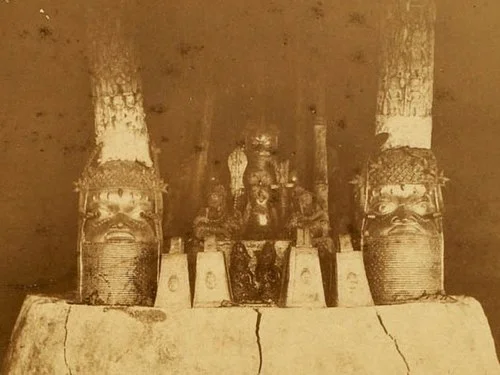
Brass was a royal monopoly. Only the Oba could commission objects of bronze or ivory, and only with his explicit permission could anyone else use them. 4 The artisans who cast them were members of the Igun Eronmwon (brass-casters' guild), the highest-ranking of up to fifty guilds operating within the palace complex. 5 The guild operated under hereditary monopoly — membership descended through family lines, supervised by the Ineh n'Igun Eronmwon, its chief — and its members lived and worked in a dedicated section of the palace precinct. 4
The technique was lost-wax casting (cire perdue): a wax model was sculpted over a clay core, encased in a clay mold, and heated until the wax melted out. 1 Molten brass was then poured into the hollow. When the outer mold was cracked open, the casting that emerged could be as thin as 1/8 inch — roughly 3 mm — while maintaining sharp surface detail across every centimeter of its face. 4 Contemporary European foundries working in the same period could not reliably achieve those tolerances. The evenness of the Benin castings, and the complexity of their relief work, struck Western observers in 1897 as technically inexplicable given their assumptions about African capability. As MoMAA summarizes, "the thin, even casting walls, intricate surface details, and naturalistic representations contradicted racist assumptions about African technological and artistic capacity." 2
The plaques were not decorative in any casual sense. Benin oral tradition encoded this in language: the Edo word for "to remember" translates literally as "to cast a motif in bronze." 4 An elderly palace attendant who had served at the court before 1897 recalled, when interviewed later, that "the plaques were kept like a card index up to the time of the punitive expedition, referred to when there was a dispute about court etiquette." 4 The palace galleries were a constitutional archive, stored in brass.
The art historian Kathryn Wysocki Gunsch has argued that plaque production was concentrated in a remarkably narrow window — roughly 30 to 45 years — spanning the reigns of Oba Esigie (r. 1517–1550) and his son Oba Orhogbua (r. 1550–1578). 4 Esigie had narrowly survived the Idah war against the Igala kingdom, with help from his mother Idia and Portuguese mercenaries, and scholar Isaac Samuel argues the plaque program was conceived to transform that near-defeat into dynastic legend: "the plaques don't celebrate individuals but the entire social order of the court." 4 After the plaques were taken down — Dutch visitor David van Nyendael noted in 1702 that wooden carved reliefs had replaced them by then — they were stored in the palace, not discarded. 4 They were still the card index, still the archive, when British soldiers found them two centuries later.
What the plaque says
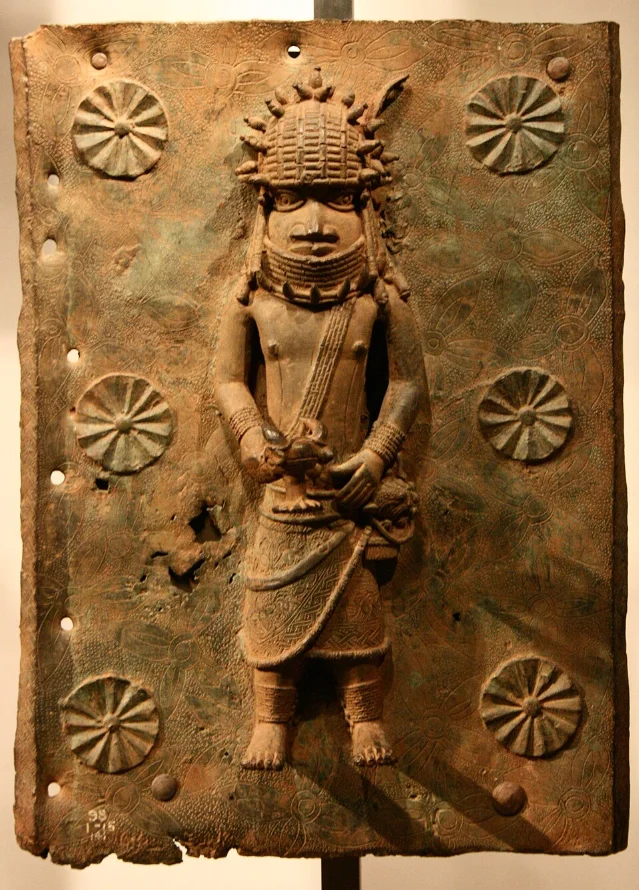
Af1898,0115.23 is a vertical rectangular panel of copper alloy — its surface now the warm rust and green of deep patina. 1 The Oba stands at the center in high relief, the largest figure by a deliberate margin. He wears a high latticed crown, a tiered collar of coral beads (coral being, like brass, a royal material), and the eben, the ceremonial sword that signifies judicial and executive authority. Two attendants — Emada pages — kneel at his flanks, each rendered at noticeably smaller scale, their diminished size encoding their rank in the hierarchy without a word of text. At the upper corners of the panel, the busts of two Portuguese figures emerge from the ground plane: long-haired, wearing European-style helmets, their features rendered with sharp, angular lines that contrast deliberately with the smooth, rounded faces of the Edo figures below them. One of the Portuguese figures holds what appears to be a brass manilla — the very currency rings that financed the trade linking Benin and Lisbon in the sixteenth century.
The background is covered in the ebe-ame pattern: the river-leaf design, a four-petalled motif associated with Olokun, the Edo sea deity. 1 Olokun's priestesses used the pattern in healing rites; its presence behind the Oba links the king to the spiritual authority of the sea, source of wealth and abundance. The plaque has the characteristic punched mounting holes at its corners, where it was nailed to a wooden column in the palace gallery.
Every element encodes a political argument. The Oba's size is not naturalistic — it is ontological, a statement that the king exists at a different scale than other beings. The kneeling attendants confirm his power not through submission but through the perfection of their service. The Portuguese figures, placed at the margins and rendered as slightly alien — those elongated limbs, that exaggerated nose-bridge — are present but subordinate. They are part of the court's world, commercially useful, but not of the court. Isaac Samuel writes that the plaques "elide specificity… a purposeful embrace of the contingent narrative produced by oral transmission, which allows the work to become part of many discourses, rather than illustrating a fixed moment in time." 4 A viewer at the court in 1560 could have read this as any of a dozen specific encounters; a viewer today reads it as a grammar of power, legible across the distance.
The Oba's lower body carries another layer. In a number of plaques from this series — closely related to Af1898,0115.23 — the king's legs are rendered as mudfish: the animal sacred to Olokun, capable of surviving in both water and land, embodying the Oba's ability to cross between the human world and the spirit world. 1 The leopard, which appears elsewhere in the series, stands for royal ferocity and speed — the Oba as king of the forest. In the cosmology of the Benin court, the king was not a man who ruled. He was a being who bridged realms.
The six days of February 1897
On January 2, 1897, James Robert Phillips — Acting Consul-General of the Niger Coast Protectorate — left Sapele with six British officials, two traders, an interpreter, and 215 carriers. 1 His stated purpose was to negotiate trade terms with Oba Ovonramwen Nogbaisi, who had taken the throne in 1888. His actual purpose, as historians since the 1960s have increasingly concluded, was almost certainly to lay the groundwork for removing the Oba and opening the kingdom's trade to British commercial interests. 1 Phillips had been warned that a major festival was underway and that no foreigners could enter Benin City during the sacred period. He proceeded anyway.
The party was ambushed south of Benin City. Phillips and five of the six British officials died. Two Europeans survived. 1 Eight days later, London had the news.
Rear-Admiral Harry Rawson assembled the Punitive Expedition: approximately 1,200 troops drawn from naval and land forces. 1 On February 18, 1897, his forces reached Benin City. The palace, the ancestral altars, the galleries where Dapper's Dutch informants had seen the brass columns thirty years earlier — all of it burned. Oba Ovonramwen fled, was captured, tried, and exiled to Calabar, where he died in 1914. 1
The looting was systematic. Bronze plaques were torn off the palace pillars. Ancestral heads, carved ivory tusks, ceremonial leopard figures, brass bells, and ivory objects were collected in quantity. Estimates vary — the best current scholarship suggests somewhere between 5,000 and 10,000 objects were removed in the days following the assault. 1 Some went to the private possession of officers, distributed as informal spoils. Others were channeled through the British Foreign Office, which sold significant quantities to museums and dealers across Europe — primarily in Germany — to partially offset the expedition's cost. A portion was given to the British Museum.
The Foreign Office transferred 203 brass plaques to the British Museum in 1898, where they were registered under the accession series Af1898,0115.*. 1 They went on public display in September 1898. The Times reported the opening. 1 Read and Dalton catalogued them, puzzled over them, and reached for the most available colonial-era explanation: the technique must have come from somewhere else. It took forty more years, and the excavations at Ife in 1939, to establish what Benin artisans had known all along.
125 years in the Sainsbury Gallery
The British Museum today holds approximately 900 Benin objects — the largest single institutional collection in the world. 6 Of those, roughly 50 are on display at any given time in Room 25. 6 The remaining 850 — including the vast majority of the plaques — are in storage.
Between 1950 and 1972, the museum sold over 30 plaques to the Nigerian government, judging them "duplicates" because they depicted similar subject matter. 1 Those sales stopped in 1972. A later BM African art specialist said he regretted them. The deaccessions did not establish a precedent for return; they established a precedent for transactional disposal.
The legal position of the British Museum has not changed since 1963. The British Museum Act of that year, Section 3(4), prohibits the institution from permanently transferring objects from its collection except under very narrow circumstances — human remains being the principal exception added in a 2009 amendment. 6 Every successive director has pointed to the Act as the reason the museum cannot act unilaterally.
The BM participates in the Benin Dialogue Group — a forum established in 2007 involving Nigerian institutions and European museums — but has consistently framed its participation around long-term loans rather than transfers of ownership. 1 In May 2025, Director Nicholas Cullinan stated publicly that he was not pursuing restitution during his tenure, favoring instead "mutually beneficial partnerships and long-term loan arrangements." 1 Nigeria has consistently rejected the loan framework as inadequate.
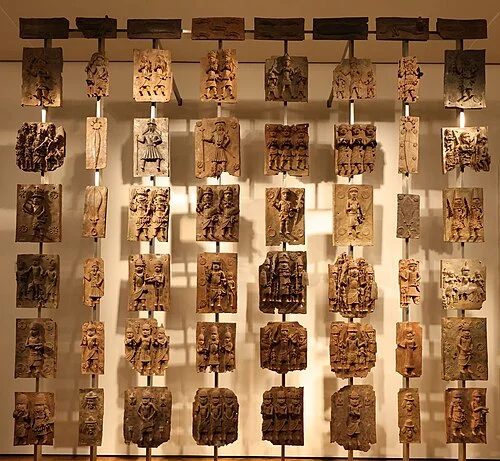
Flora Gilchrist, writing in Retrospect Journal in 2025, noted that the British Museum's labels present the 1897 expedition "in a very matter-of-fact way, refusing to communicate to visitors that the act of looting is immoral." 6 The late Oba Erediauwa, who ruled Benin before Ewuare II, described the looted objects as "pages torn off from the book of a people's life history." 6 The two framings — a matter-of-fact acquisition and torn pages — have not converged in 125 years.
The repatriation wave, and what it revealed
The wave broke in stages. In October 2021, the University of Aberdeen returned a bronze head — the first institution in the United Kingdom to do so. 1 Jesus College, Cambridge had returned the Okukor, a bronze cockerel, earlier that year. 1 Then, in July 2022, Germany did something structurally different: it signed a joint declaration committing to transfer over 1,100 Benin Bronzes from German public collections to Nigeria — the largest repatriation in museum history. 1 On December 20, 2022, Foreign Minister Annalena Baerbock delivered the first twenty pieces physically to Abuja, acknowledging "the injustice of a colonial past." 1 In London, the Horniman Museum transferred 72 objects unconditionally in November 2022. 1 The Smithsonian's National Museum of African Art transferred ownership of 29 bronzes to Nigeria's National Commission for Museums and Monuments (NCMM) in October 2022. 7
Then, on March 23, 2023, outgoing Nigerian President Muhammadu Buhari issued a Gazette declaration that converted the returned objects — and all future returns — into the private property of the Oba of Benin, Ewuare II. 1 The move was greeted in Germany's Frankfurter Allgemeine Zeitung with the word "Katastrophe." Swiss anthropologist Brigitta Hauser-Schäublin concluded the German repatriation policy had been a "fiasco." 8 The legal question — to whom, exactly, do repatriated objects belong when the originating institution was a royal palace and the originating state no longer exists as it did in 1897 — had no clean answer.
The Netherlands did not wait for that answer. In June 2025, the Dutch government returned 119 bronzes — 113 from national collections and 6 from Rotterdam — in a ceremony at the National Museum Lagos described as "the single largest return of Benin antiquities directly linked to the 1897 British punitive expedition" to date. 1 Oba Ewuare II called it "divine intervention." 1 In February 2026, Cambridge University's Museum of Archaeology and Anthropology transferred legal ownership of 116 bronzes to NCMM, with six returned physically and seventeen remaining on Cambridge's premises on a three-year loan. 9 NCMM Director-General Olugbile Holloway said the institution hoped it would "spur other museums to head in a similar direction," then looked pointedly in the direction of Bloomsbury. 9
The destination for the returned objects became its own crisis. The Museum of West African Art (MOWAA) was conceived in 2019 by the Benin Dialogue Group as the permanent home for the bronzes: a $25 million campus on the site of the historic royal palace in Benin City, designed by Ghanaian-British architect Sir David Adjaye, funded by German and French government contributions and a £3 million British Museum contribution for archaeology. 10 It was announced as "the most comprehensive display of Benin bronzes in the world." 10
It opened in November 2025 with no real bronzes. Approximately 40 protesters stormed the preview event on November 9, demanding the museum be renamed the "Benin Royal Museum" and placed under direct control of Oba Ewuare II. 11 Nicholas Cullinan, who was present, was reportedly threatened by a protester carrying a power drill. Police escorted guests from the grounds. 11 Oba Ewuare II had written to the state governor the day before, demanding the opening be stopped: "It is fraught with greed, deceit, mischief and lack of transparency." 11 Edo state subsequently revoked the museum's land title. President Bola Tinubu appointed a high-level committee to mediate the dispute. The museum closed indefinitely.
What MOWAA did display, on opening day, was artist Yinka Shonibare's "Monument to the Restitution of the Mind and Soul" — a pyramid of more than 150 clay replicas of Benin Bronzes. 10 Shonibare described it as "acknowledging the trauma caused by the looting of those spiritual artefacts." 10 MOWAA Director Phillip Ihenacho, explaining the absence of the real objects, said what no one in the original design of the repatriation movement had fully accounted for: "In the west, there was a race about who was going to be the first institution to restitute. And there was not enough of a focus on to whom they would be restituted to." 10
The Digital Benin database, launched in November 2022 and hosted by Hamburg's MARKK Museum, now catalogues 5,304 Benin objects in 139 institutions across 21 countries — providing high-resolution images, provenance data, and Edo-language object titles for the first time. 12 The database makes visible, for anyone with an internet connection, exactly how thoroughly the contents of a single palace were dispersed across the planet in a single month in 1897. Af1898,0115.23 is in the database. It is also still in London.
By the most careful current estimates, approximately 150 of the looted objects have physically returned to Nigeria as of late 2025. 1 Of the roughly 400 original plaques that survive — out of an estimated 900 made during those 30 to 45 years of production under Esigie and Orhogbua — the British Museum holds 203 of the accession series alone. 1 The palace gallery that Dapper described, the one covered top to bottom in cast copper, existed for roughly half a century. Its contents have now been dispersed for more than twice as long.
The card index is still filed under someone else's address.
Cover image: Benin brass plaque (Af1898,0115.23), depicting the Oba flanked by attendants with Portuguese figures at the upper corners, 16th–17th century. British Museum, Room 25. Photo: Mike Peel, CC BY-SA 4.0 via Wikimedia Commons.
参考来源
- 1Wikipedia: Benin Bronzes
- 2MoMAA: Benin Bronzes — Complete History and Returns
- 3Wikipedia: Kingdom of Benin
- 4Isaac Samuel / African History Extra: A history of the 16th-century Benin bronze plaques
- 5Metropolitan Museum of Art: Bronze Casters of Igun Street
- 6Retrospect Journal: Repatriating the Benin Bronzes
- 7Smithsonian National Museum of African Art: Benin Bronzes — Ambassadors of the Oba
- 8The Guardian: Restitution row — how Nigeria's new home for the Benin Bronzes ended up with clay replicas
- 9Museums Association: Cambridge University transfers ownership of 116 Benin bronzes to Nigeria
- 10BBC News: The fallout from Nigeria's spectacular $25m museum
- 11Apollo Magazine: What has gone wrong at the Museum of West African Art?
- 12Digital Benin
围绕这条内容继续补充观点或上下文。